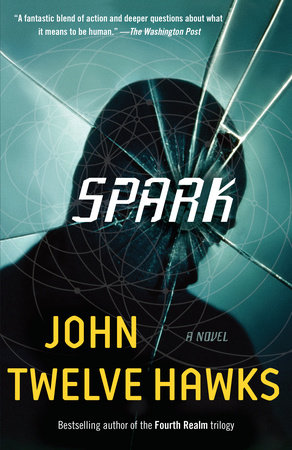
SPARK by John Twelve Hawks — book cover
A Reading Group Guide

Fifteen questions to take your book club inside Spark.

A free discussion guide for John Twelve Hawks's novel about a man who believes he is dead — plus the printable PDF and the rest of the bonus library, sent to your inbox.

About the Book

A perfect killer who cannot feel — until something stops him.

Spoiler-aware. These questions assume you've finished the novel.

Jacob Underwood had a motorcycle accident that changed everything. The traumatic brain injury left him with Cotard's Syndrome, a rare neurological condition that makes him believe he is dead. He feels no emotions, no fear, no connection to other people. He refers to his body as a "Shell" and his consciousness as a "Spark" — a point of light trapped inside a prison of flesh and bone.

In a near-future New York saturated with surveillance cameras, tracking chips, and an omniscient government database called EYE, Jacob works as a hired assassin for Miss Holquist, a coolly philosophical handler who runs the Special Services Section of a powerful investment bank. Jacob is the perfect killer: he cannot feel guilt, cannot be frightened, and sees human beings as objects no different from furniture.

When an assignment takes him from New York to London, India, and Paris, Jacob is ordered to kill a family — including a six-year-old boy. For the first time since his Transformation, something stops him. That failure sets off a chain of events that forces Jacob into contact with Emily Buchanan, a young woman who has stolen files revealing a conspiracy behind the terrorist attack known as the Day of Rage.

Spark is a thriller narrated from inside a mind that cannot feel, a love story between two people who shouldn't be able to connect, and a philosophical inquiry into what it means to be human in a world where machines are learning to imitate us — and we are learning to imitate them.

Questions for Discussion

Fifteen ways in.

  1. The novel opens with a long passage asking the reader to forget everything — faith, beauty, taste, smell, moral judgment — and ends with: "Do all this and you might become me." What effect did this opening have on you? Did it make you sympathize with Jacob or recoil from him?
  2. Jacob insists that he is dead, and his doctors tell him this is a delusion caused by brain damage. The novel never fully resolves this tension. Do you think Jacob is deluded, or has his injury given him a real insight into the nature of consciousness? Does the distinction matter?
  3. Jacob's relationship with his Shadows — Laura and Edward — is one of the most intimate in the novel. He imagines Laura's appearance, chooses her personality settings, and asks her to sing him a sad song. Are these relationships a substitute for human connection, or are they something else entirely? What does it mean that Jacob's most trusted companions are software programs?
  4. Miss Holquist delivers a speech about bosons and fermions, arguing that morality does not exist because everything reduces to physics. Jacob seems to accept this worldview. Do you find her argument persuasive? How does the novel ultimately respond to it?
  5. When Jacob cannot kill Sanjay in Paris, the boy's eyes seem to radiate "waves of energy" that penetrate his Shell. What is it about the child that reaches Jacob when nothing else can? Is this a spiritual moment, a neurological one, or both?
  6. The novel takes place in a world shaped by the Day of Rage — a terrorist attack on schools in nine countries. The attack led to sweeping surveillance laws, the EYE system, and mass arrests. By the end of the novel, we learn the attack was secretly financed by a powerful banker. How does this revelation change the way you understand the novel's world? Does it comment on real-world events?
  7. Jacob watches the documentary A Boy for Baxter hundreds of times. He identifies with Gordon, the brain-damaged boy, and wishes he had a service dog that could interpret human emotions for him. What does this recurring motif tell us about what Jacob has lost — and what he still wants?
  8. The Vickerson family — Boz, Ernie, and Millicent — live by the motto "If you decide to do something, then do it well." Sean believes in "the politics of doing something." Thomas Slater argues that humans must justify their uniqueness in an age of machines. How do these characters represent different responses to the surveillance society? Which response does the novel seem to favor?
  9. Millicent makes Jacob a cup of hot chocolate, and for the first time since his Transformation, taste triggers a memory — "a rainy afternoon with my mother, steam rising from a cooking pot while teddy bears danced on a yellow cup." Why is this moment significant? What does it suggest about the relationship between the body and consciousness?
  10. Jacob experiences smell as color — garbage is "brownish green," blood is "bright red — a noisy, urgent color," the Vickerson workshop smells "butterscotch brown." This is a form of synesthesia. How does this sensory condition shape the way Jacob perceives the world? Does it make him more or less human?
  11. Lorcan Tate is Jacob's dark mirror — another killer, but one who takes pleasure in violence. When Lorcan cuts a cross into Jacob's chest to prove he is alive, is he right? Does physical pain prove existence? How does this scene contrast with Jacob's later decision to save Emily?
  12. In Paris, Jacob visits the Conservatoire and watches the Keeper of the Automates demonstrate mechanical figures from the eighteenth century. The Keeper tells him that the Bleeding Man — Vaucanson's masterpiece — may still be walking the streets: "Unlike fragile humans, Vaucanson's creation cannot die." How does this scene connect to the novel's larger questions about the difference between humans and machines?
  13. Emily tells Jacob: "We all make choices every day. Do this or do that. Add it up, it's who we are." Thomas Slater says: "Unlike machines, we can always choose a new direction." The novel is deeply concerned with whether free will exists. Does Jacob have free will? Does anyone in the novel?
  14. At the climax, Jacob tells Emily: "You're a nail and a cord for me. Thinking about you makes me feel like I'm not going to fly away and dissolve into random particles." Jacob walks in literal circles around a nail in his apartment to calm himself. What does it mean that he uses this image to describe Emily? Is this love, dependence, or something the novel suggests has no name?
  15. The novel ends with Jacob wounded, bleeding, and driving toward the hospital where he was first treated — asking Laura for directions, wanting to live. Is this a hopeful ending? Has Jacob been "cured" of Cotard's Syndrome, or has he simply chosen to act as if he is alive? What is the difference?
Themes for Further Exploration

Where the conversation goes next.

The Spark and the Shell

Jacob's private vocabulary — Spark, Shell, Transformation, Human Unit — is both a symptom of his condition and a philosophical framework. His language strips away the assumptions most people make about being alive. How does his terminology change the way you think about consciousness, the body, and the relationship between the two?

Surveillance and freedom

The EYE system, Freedom Cards, the Norm-All program, and the G-MID glasses create a world where every citizen's behavior is monitored, predicted, and controlled. The growlers, the New Luddites, and the squatters at Housing for Us each resist this system in different ways. What does the novel suggest about the cost of total surveillance — and whether resistance is possible?

Machines and emotion

From the pleasure bots in Paris to the nubot receptionist at InterFace, the novel is populated with machines that simulate human behavior. Jacob himself is sometimes mistaken for a machine. The Turing Test asks whether a machine can pass for human — but Spark asks the reverse: can a human pass for a machine? And what happens when the answer is yes?

Violence and its consequences

Jacob kills without feeling — until he doesn't. The novel tracks his journey from detachment to something that might be conscience. Does the novel judge Jacob for the people he has killed? Does it forgive him? Should the reader?

The role of art

Bach's music, the automates, A Boy for Baxter, Laura's sad Irish song, the Vickersons' handcrafted furniture — the novel is full of moments where human-made things reach Jacob when human beings cannot. What does this suggest about the power of art, craft, and beauty to penetrate even the most damaged consciousness?
Take it with you.

Drop your email and we'll send the printable PDF — plus the Certainty reading group guide, the film adaptation update, and the first essay in A Life in the Shadows.

No spam. Unsubscribe any time.