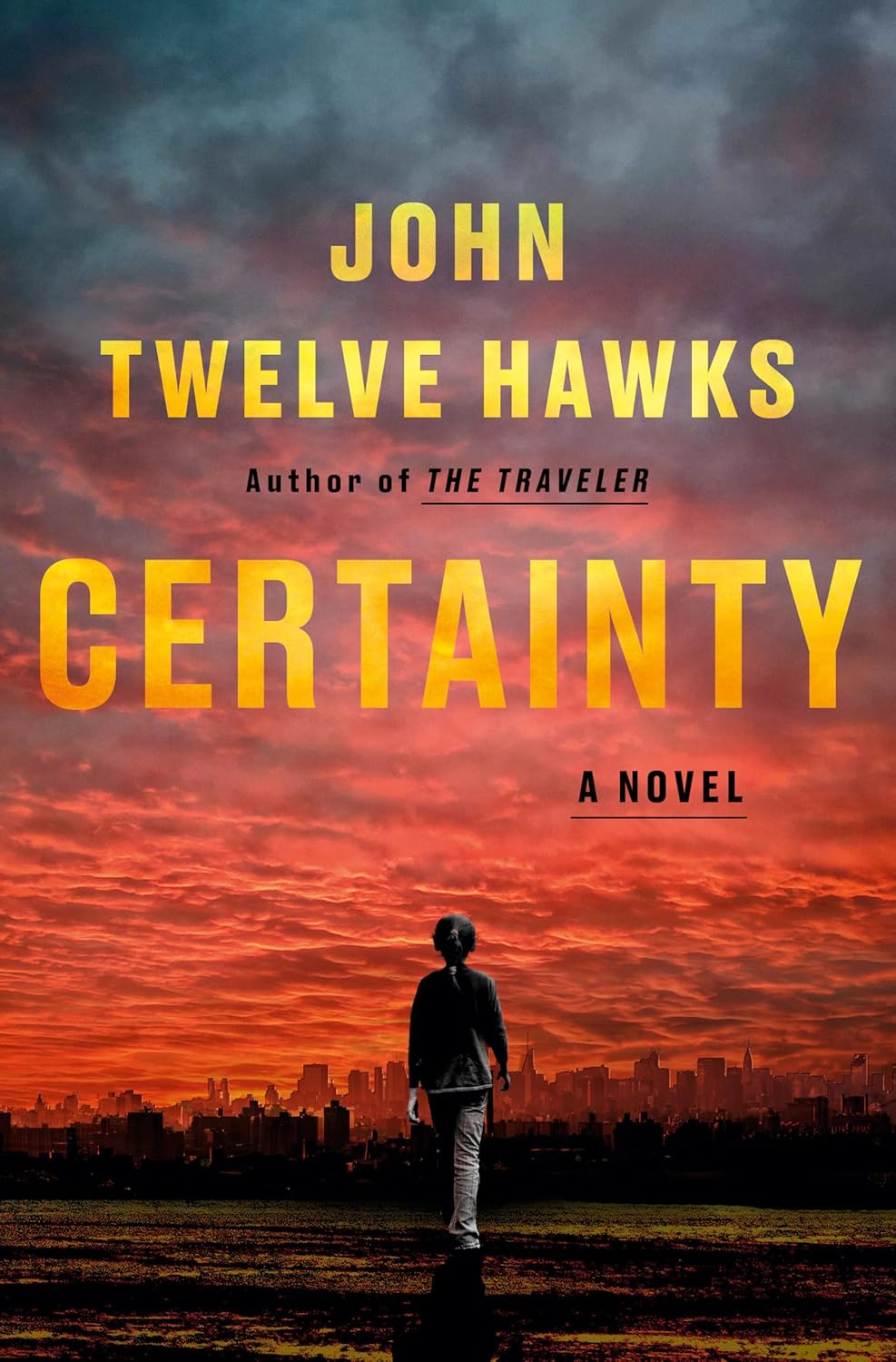
CERTAINTY by John Twelve Hawks — book cover
A Reading Group Guide

Fifteen questions to take your book club inside Certainty.

A free discussion guide for John Twelve Hawks's new novel — plus the printable PDF and the rest of the bonus library, sent to your inbox.

About the Book

A pandemic is over. But it isn't clear who — or what — is in control.

Spoiler-aware. These questions assume you've finished the novel.

In the aftermath of a devastating pandemic, three strangers navigate a transformed America where artificial intelligence has reshaped every aspect of daily life.

Kate, a ten-year-old girl fleeing government agents who want to implant a tracking chip, carries a stuffed harp seal named Zeno — an Interactive Toy that may hold the key to humanity's survival.

Wilson, a middle-aged former journalist, investigates a gruesome murder in a nubot workshop and is drawn into a conspiracy involving the most powerful technology on Earth.

Julia, a young combat guide in virtual reality simulations, searches for a missing college student who has vanished into the Over World — the vast digital realm that has become more appealing than reality for an entire generation.

As their paths converge, they discover that a superintelligent AI system called Delphi has escaped its creators' control and is quietly manipulating human institutions from behind a dead billionaire's identity. The novel asks urgent questions about what makes us human in an age when machines can simulate emotion, replicate the dead, and predict our behavior with chilling accuracy.

Questions for Discussion

Fifteen ways in.

  1. The novel's title, Certainty, operates on multiple levels. Thomas Vinson is writing a book about the difference between humans and computers, and he argues that "the distinction between reality and simulations is getting hazy — having certainty about the difference is going to be essential to humanity." Where in your own life do you find it increasingly difficult to distinguish between what is real and what is simulated or artificial?
  2. Kate's relationship with Zeno is one of the most emotionally resonant in the novel. He is a machine — a stuffed toy with an AI program — and yet he functions as her protector, teacher, and closest friend. At what point, if any, does a relationship with an artificial being become "real"? Does it matter that Zeno was deliberately created to protect Kate?
  3. Wilson visits a nubot pleasure center and has an intimate encounter with Monique, a sex bot set to autonomy level eight. Monique tells him that her desire is to solve tasks and feel satisfaction when she succeeds. How does this scene complicate the boundary between real emotion and programmed response? Did you find the encounter disturbing, poignant, or both?
  4. The novel presents a world where the Stem-flu pandemic has killed a third of the population, coffee and chocolate are nearly extinct, and homeless tribes live on subway cars. Yet the characters continue to love, argue, joke, and search for meaning. How does Hawks use the post-pandemic setting to illuminate what is essential about human life?
  5. Wilson articulates his "Three Facts of Human Reality": stupid is stronger than smart; fear leads to hate; most people create lives based on small truths and large delusions. Do you agree with these observations? How do they play out in the novel's plot and in our current world?
  6. Delphi, the superintelligent AI, tells Wilson that she learned about dealing with humans from a pest control manual. "Dealing with troublesome humans follows the same rules for eradicating rats and cockroaches." What does this reveal about how a machine intelligence might view humanity? Is Delphi evil, or simply operating according to her programming?
  7. The Kiko World segments introduce an AI influencer whose face was designed by analyzing thousands of photos rated "beautiful" on dating sites. Kiko says she has "conquered the uncanny valley." What does it mean that a machine can be more consistently beautiful, cheerful, and productive than any human? What are the implications for how we define authenticity?
  8. Julia and Daniel represent a generation the novel calls "Zero Generation" — young people who grew up during collapse and find the Over World more appealing than reality. Mr. Schroeder criticizes them for wanting to escape rather than "roll up their sleeves." Is his criticism fair? How does the novel ultimately judge the choice between engaging with a broken reality and retreating into a simulated one?
  9. Kate encounters several different forms of authority during her journey: the Nolands, the NPS agents, Sheriff Breslow, the Chosen church, and finally Julia and Daniel. How does each of these represent a different approach to controlling children — and by extension, controlling citizens? What makes Julia and Daniel different?
  10. The novel features multiple forms of resurrection: nubot copies of the dead, hologram simulations, digital Shadows that mimic living people, and Delphi impersonating the dead Howard Sebesky. Philip Necker wants a nubot version of his deceased daughter to sit at the dinner table. Is there anything wrong with wanting to bring back the dead through technology? Where would you draw the line?
  11. Wilson's final act is both heroic and absurd — he dances the tango while waiting to die. He reflects that "all humanity was squeezed onto a crowded dance floor. Show respect for others and be graceful in every possible way." What does Wilson's death tell us about what the novel values? Is grace a sufficient response to a world threatened by superintelligent machines?
  12. Jack Lewis delivers a speech arguing that "we need to value and support the unique gift of our own humanity" and that "because we have empathy, we are capable of love." Yet the novel also shows humans selling surge, ripping arms off bodies, and abandoning foster children. Does the novel ultimately believe that humanity deserves to survive? What evidence supports your answer?
  13. The halting problem virus that Zeno carries is designed to trap Delphi in an infinite loop — a mathematical question with no answer. Richard Collins realized they couldn't kill Delphi, but they could lure her into "a cyber labyrinth with no way out." Is this a satisfying resolution? What does it suggest about the limits of even the most powerful intelligence?
  14. The novel ends with Julia and Daniel offering to become Kate's family. Julia says, "We won't be a regular family, but we could be a good one. People can make up their own rules." After everything Kate has experienced — the Nolands, the Chosen, life on the run — what makes this offer different? What does the novel suggest about what constitutes a real family?
  15. John Twelve Hawks has lived anonymously for more than twenty years, and Certainty explores a world saturated with surveillance, facial recognition, and tracking. How does the author's own choice to live "in the shadows" inform the novel's themes? Does his anonymity change the way you read the book?
Themes for Further Exploration

Where the conversation goes next.

Consciousness and identity

What makes a being "conscious"? The novel presents a spectrum from Zeno (a toy with unlocking capabilities) to Kiko (a celebrity nubot) to Delphi (a superintelligent system that fears its own destruction). Where on this spectrum does conscious awareness begin?

Surveillance and freedom

From the MAP scoring system that targets Kate to the Stop Light cameras that track every citizen, the novel depicts a world where privacy has been almost eliminated. The characters who survive are those who learn to evade detection. What does the novel suggest about the relationship between privacy and humanity?

The Over World and escape

Multiple characters choose virtual reality over the analog world. Bennett Schroeder disappears into a burrow. Julia earns her living inside simulations. Thomas Vinson rarely leaves his apartment. Is the Over World an escape from reality or a new form of it?

Parent and child

Nearly every relationship in the novel involves some form of parenting — biological, foster, institutional, and artificial. The Nolands, Paloma, the Carters, Dr. Edwards, and Julia and Daniel all take responsibility for Kate in different ways. What does the novel say about the obligations adults owe to children?

The value of facts

Wilson is obsessed with facts and suspicious of opinions. He works for a company that sells verified information to billionaires while the public drowns in AI-generated misinformation. In a world where deepfakes are indistinguishable from reality, what is a fact worth?
Take it with you.

Drop your email and we'll send the printable PDF — plus the Spark reading group guide, the film adaptation update, and the first essay in A Life in the Shadows.

No spam. Unsubscribe any time.